Sooner or later someone asks you the question. A friend, a cousin, a colleague who has finally had enough: “I want to try Linux. Which distribution should I install?”
You make the mistake of searching online. You find a list longer than a supermarket receipt, a forum thread with four hundred replies and nine different answers, a video titled “THE ONLY DISTRO YOU’LL EVER NEED (2025)” and, inevitably, someone suggesting you compile everything yourself.
Take a breath. The cow has been watching this debate for years, and she has some good news: it matters much less than you think.
The family tree
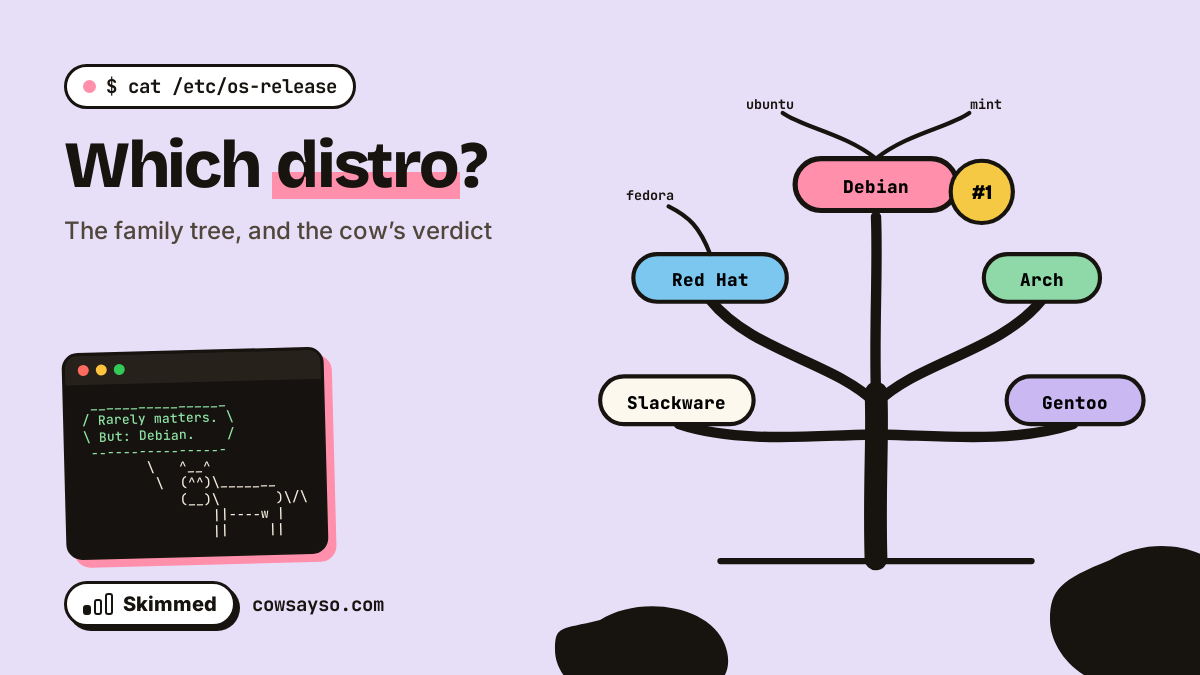
There are hundreds of distributions, but almost all of them descend from a handful of big families. If you know the ancestors, you know nearly everyone:
- Debian, founded by Ian Murdock in August 1993. Its children include Ubuntu, and Ubuntu’s children include Linux Mint. Debian has a lot of grandchildren.
- Red Hat, whose community distribution is Fedora, born in November 2003 as the continuation of Red Hat Linux. Fedora is sponsored by Red Hat and is the upstream for its enterprise system, Red Hat Enterprise Linux.
- Slackware, released by Patrick Volkerding in July 1993: the oldest distribution still maintained, and the base of the very first versions of SUSE.
- Arch, started by Judd Vinet in 2002: always up to date (“rolling release”), minimal, and famous for its wiki.
- Gentoo, by Daniel Robbins, version 1.0 in 2002: you compile the software yourself, from source, on your own machine. It has even been used to build ChromiumOS.
What really changes (spoiler: not much)
Under the hood, they all run the same Linux kernel. They all run the same browsers, the same office suites, the same desktops. What changes is mostly three things:
- How you install software:
apton Debian and its family,dnfon Fedora, something else elsewhere. - How often things change: some distributions freeze everything for years, others update every day.
- The default choices: which desktop, which settings. All of them changeable in an afternoon.
Debian or Fedora: the two simple ones
If you want something that works without unnecessary complications, the choice comes down to two. They differ mostly in one thing: how often they change.
| Debian | Fedora | |
|---|---|---|
| Born | 1993 | 2003 |
| Who makes it | A community of volunteers | A community, sponsored by Red Hat |
| Installing software | apt (.deb packages) | dnf (RPM packages) |
| New versions | Every few years. Debian 13 came out in August 2025 | About every six months |
| How long a version lasts | Five years: three of full support, two of long-term support | About thirteen months |
| Personality | Calm, solid, slightly behind the latest fashion | Up to date, curious, you upgrade at least once a year |
In short: Debian is the friend who still has the same car after ten years, and it still starts every morning. Fedora is the friend who always has the latest phone, and it works, as long as you remember to update it.
Why not something harder
Arch, Gentoo and Slackware are excellent. They are also more work: you configure more things by hand, you follow updates more closely, you read more documentation (the Arch wiki is famously good, which is lucky, because you’ll be reading it a lot). That work teaches you a great deal. But if what you want is to use the computer, it’s time not spent on what you actually wanted to do.
And then there is the final level: Linux From Scratch. It isn’t a distribution, it’s a book, started by Gerard Beekmans in 1999, with step-by-step instructions to build your own Linux system entirely from source code. Every piece, by hand, one at a time. It’s one of the best ways ever devised to understand how a Linux system is put together.
Exotic and trendy: handle with care
Every year there’s a new distribution everyone is talking about: a beautiful theme, a clever installer, a passionate small team. Sometimes it’s wonderful. Sometimes it ends.
Antergos, a popular distribution based on Arch, announced its end on 21 May 2019: the volunteers no longer had enough time. Its users had to move elsewhere (part of the community started a successor, EndeavourOS). It wasn’t anyone’s fault. It’s simply what happens when a lot of people depend on a few people’s free time.
And it doesn’t only happen to small projects. CentOS Linux 8 was expected to be supported until 2029. In December 2020 the project announced that it would end on 31 December 2021 instead. Many companies had to change plans in a year.
The cow’s verdict
So here’s the truth nobody puts in the video titles: changing distribution rarely changes anything that matters. The same kernel, the same programs, the same you. The day you spend distro-hopping is a day you could have spent learning to use the one you already have.
But you asked the cow. And the cow, who lives in apt-get moo and whose favourite birthday is 16 August, has an answer. Debian. This very blog runs on it.
Moo. 🐄
Sources
- Debian Wiki, “Debian Day”
- Debian, “Debian Releases”
- Fedora Docs, “Fedora Linux Release Life Cycle”
- Wikipedia, “Fedora Linux”
- Wikipedia, “Ubuntu”
- Wikipedia, “Linux Mint”
- Wikipedia, “Slackware”
- Wikipedia, “Arch Linux”
- Wikipedia, “Gentoo Linux”
- Linux From Scratch
- Wikipedia, “Linux From Scratch”
- Wikipedia, “Antergos”
- CentOS Project, “CentOS Linux EOL”
- CERN, “CentOS Linux 8”